Most teams ask this question with a budget in front of them and room for one. The honest answer is that a source code review and a penetration test answer different questions, and the right choice depends entirely on which question is currently costing you.
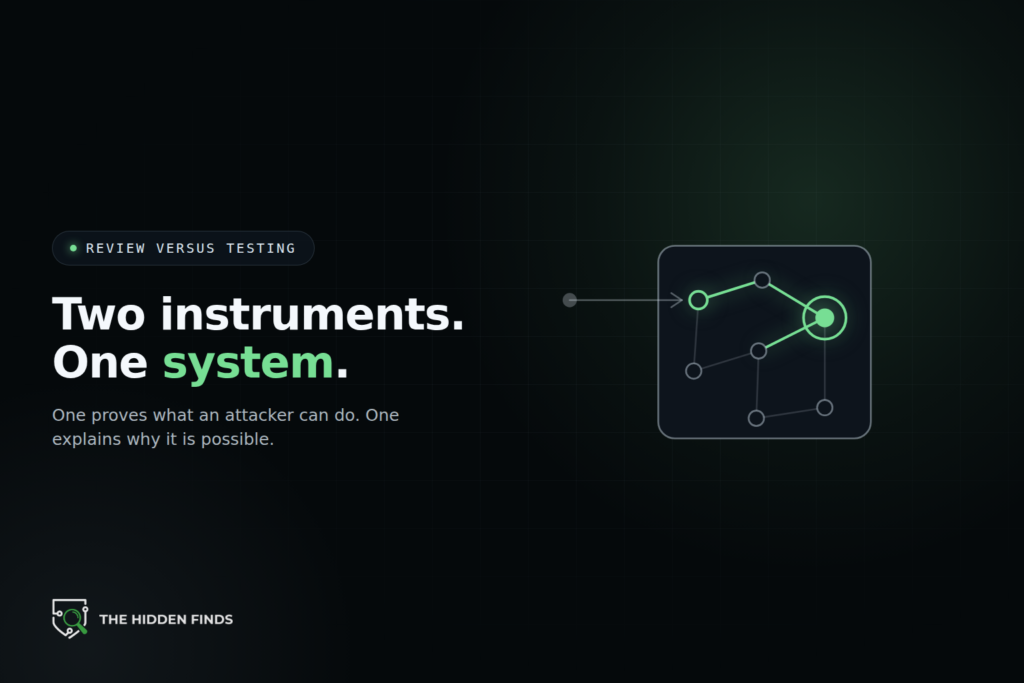
A penetration test tells you what an attacker can do to the system you are running today. A source code review tells you why that is possible and where else the same mistake exists. One proves impact. The other explains cause. Neither replaces the other, and the order you buy them in should depend on what you already know about your own application.
The Short Answer
Buy a penetration test first if you need to demonstrate real impact to someone, if your application has never been tested, or if the thing you need is proof that a specific attack path works. A test ends with a working exploit chain and a report that a board or a customer can read.
Buy a source code review first if you already know something is wrong and need to find every instance of it, if you are about to ship a feature that changes the permission model, or if your concern is the code paths nobody has reached from the outside yet. A review ends with a cause, a line number and a list of the other places it reaches.
Everything below is the reasoning behind that, and the cases where it is wrong.
What a Penetration Test Actually Does
A penetration test works from outside the application, through the same interfaces an attacker would use. The tester gets accounts, maps the surface, and then attacks it. The deliverable is proof: not that a weakness exists in theory, but that it can be exploited here, by someone with this level of access, to produce this specific result.
That framing matters. A finding that reads “a standard member of organization A can retrieve the billing records of organization B by changing an identifier” is something a customer, an auditor and a board can all understand without a security background. A proper penetration test report is written to be acted on by people who were not in the room.
Testing also catches an entire category the code cannot describe. Configuration. Infrastructure. A security header missing at the load balancer. A staging environment reachable that nobody mentioned. Session behaviour that depends on how the token store is deployed rather than on how it was written. Anything that emerges from how the system runs rather than how it was coded is only visible in a test.
What it cannot do is see past the edge of what is reachable. If an endpoint exists but nothing links to it, if a branch only runs behind a feature flag, if an administrative path requires a role the tester was never given, a test may never touch it. Coverage is bounded by exposure.
What a Source Code Review Actually Does
A source code review works from the inside. Rather than probing endpoints, I read the code that makes security decisions: where authorization is enforced, how ownership is checked, how tenant scoping is applied, what the business rules actually do rather than what they are supposed to do.
The difference in coverage is structural. A review sees every route, including the ones no interface links to, the ones behind flags, the administrative paths, the background jobs and the scheduled tasks that run with elevated privilege and no request context. It sees the code that will ship next month alongside the code that shipped last year.
The difference in output is more important. A test finds a symptom. A review finds a cause.
That distinction is not academic, and it is the single strongest argument for reading code. Consider what each one produces from the same underlying flaw.
The Same Flaw, Seen Two Ways
An endpoint returns an invoice. It checks that the caller is authenticated. It checks that the caller has the member role. It never checks who owns the invoice.
What the test produces. The tester tries another tenant’s identifier on that endpoint, gets a 200 with the record, and writes it up. One finding, with proof, correctly rated high. Your team fixes that endpoint.
What the review produces. I read the handler, see the missing ownership filter, and follow the query helper it calls. That helper has no tenant column in its predicate at all. Eleven other endpoints call the same helper. The finding is not an endpoint, it is a shared function, and the fix belongs in one place rather than twelve.
The test found one door. The review found the lock that was never fitted, and every door using it.
This is why broken access control and IDOR findings behave differently from most vulnerability classes. They are rarely isolated. When a team has got the ownership check wrong once, they have usually got it wrong in a pattern, and the pattern is visible in the code long before it is visible from outside.
What Each One Is Blind To
Both have real gaps, and a provider who tells you otherwise is selling.
A penetration test cannot see code that is not reachable yet, the full set of places a flaw occurs, logic that requires a specific internal state to trigger, or anything behind a role it was not given. It also cannot tell you that twelve endpoints share a defect, only that the one it tried does.
A source code review cannot see configuration, infrastructure, deployment differences between environments, the behaviour of a third party service you do not control, or anything that emerges at runtime. Code that looks correct can behave incorrectly once a reverse proxy, a cache or an environment variable is involved. A review also cannot prove exploitability to a sceptical audience the way a working exploit can.
There is one more asymmetry worth knowing. A review requires your source, which means an NDA and a decision about repository access. A test requires a working environment, test accounts in multiple roles, and a window where you are comfortable with someone attacking it. Those are different kinds of friction, and for some organizations one is dramatically easier to arrange than the other.
White Box, Black Box and Grey Box, Plainly
These terms get used loosely, so here is what they mean in practice.
Black box means the tester starts with no more than a public user would have. It models an external attacker accurately and it wastes a lot of expensive time on reconnaissance you could have simply handed over.
Grey box means the tester gets accounts, roles, documentation and a conversation about how the application works. This is how most competent SaaS testing runs, because the realistic threat is not an anonymous stranger. It is someone who already has an account, which is anyone who signed up.
White box means the tester also gets the source code. In practice that is a penetration test and a source code review run together, feeding each other. Something spotted in the code gets confirmed against the running application. Something odd in a response gets traced back to the line that caused it.
If you hear “white box penetration testing”, that is what is being described. It is the most complete option and it is the right answer when the budget allows, because the two halves make each other faster.
Which One First, By Situation
You have never had a security assessment. Start with the penetration test. You do not yet know what your exposure looks like from outside, and you need the baseline a test gives you. A review on an untested application often produces a long list that nobody can prioritise.
You just found a serious bug, or a customer reported one. Start with the review, and scope it tightly around that bug. The question that matters now is not whether the bug is real, you know it is. It is whether the same mistake exists in nine other places.
You are shipping a feature that changes the permission model. Review. New roles, new sharing mechanics, a new integration that reads data on a user’s behalf. These are the changes that break tenant isolation, and reviewing them before deployment costs a conversation rather than an incident notice.
A customer’s security questionnaire is blocking a deal. Penetration test. The questionnaire almost always asks for a recent third party test, and a report is what unblocks procurement. Add the review if the questionnaire also asks about secure development practices.
You are preparing for SOC 2 or ISO 27001. Both eventually, test first. The test is the evidence auditors expect to see. The review supports the secure development control, and it tends to be where teams discover the control they documented is not what the code does.
You inherited the codebase. Review. An acquisition, an agency handover, a rewrite of something undocumented. You are taking on whatever is in there, and reading it is faster than discovering it.
You have an API with more surface than interface. Either, but scope it around the API. Most of the serious findings in modern SaaS live there, and both methods cover it well as long as the scope says so explicitly.
If Your Problem Is Coverage Rather Than Depth
There is a third thing that is neither of these, and teams often buy the wrong one because they do not know it exists.
If your actual question is “what is wrong across everything we have” rather than “how bad can this one thing get”, that is a vulnerability assessment. It is breadth first: enumerate the whole attack surface, identify weaknesses across all of it, validate what is real, rate it. It will not chain findings into a dramatic exploit, and it is not supposed to.
A useful way to hold the three apart. An assessment catalogues. A test proves. A review explains. If you are not sure which you need, the honest answer usually falls out of what you plan to do with the report.
And if the comparison you are actually making is between testing and automated scanning rather than between these two, that is a different question with a clearer answer.
Running Both, and Why It Is Not Double the Work
When a review and a test run together, each one shortens the other.
The review tells the tester where to look. Instead of probing two hundred endpoints evenly, the test goes straight at the eleven that share a suspect helper. Instead of guessing which parameters might be interesting, it knows which ones reach a query unfiltered.
The test tells the review what is real. A suspicious pattern in code is a hypothesis until something confirms it. With the application running alongside, a questionable ownership check stops being “this looks wrong” and becomes “this returns another tenant’s record, here is the request”.
The combination also changes the severity ratings, usually downward on the noise and upward on the things that matter. Code that looks dangerous but is unreachable gets correctly deprioritised. A finding that looked minor in isolation gets raised when the code shows it chains into something else.
This is the argument for a white box engagement rather than two separate purchases months apart.
What to Ask Before You Buy Either
Four questions separate a real engagement from an expensive export, and they work on both.
How many accounts and roles do you need, and why. For a test, the answer should include at least two roles and, for a multi tenant product, two separate tenants. Anything less and authorization and tenant isolation cannot be tested at all, which removes the highest value category of findings before the work starts.
What do you do with automated output. For a review, if the answer is that a SAST tool produces the findings, you are buying a tool run. Static analysis cannot see a missing authorization check, because nothing in that code is malformed. A check is simply absent, and absence has no signature.
Can I see a sample report. Look for whether a developer could act on it without a follow up call. File, line and function for a review. Request, response and account used for a test. Severity with reasoning rather than a generic score.
How is severity decided. The same technical flaw can be trivial in one application and critical in another. If everything in the sample report is high, the ratings are decoration. Severity should be argued in terms of what an attacker gains in your application specifically.
Final Thoughts
The framing of source code review versus penetration testing is slightly wrong, and I have used it throughout this article because it is what people search for. In practice they are not competitors. They are two instruments pointed at the same system from opposite sides.
If you have to pick one, pick based on what you will do with the answer. If you need to convince someone, buy the proof. If you need to fix something properly, buy the explanation.
If you want to talk through which fits your application, get in touch with the stack, the rough size of the codebase and what you are actually worried about. I will tell you which one to buy, and say so if the answer is neither.
Frequently Asked Questions
Is a source code review better than a penetration test?
Neither is better. They answer different questions. A penetration test proves what an attacker can do to the running system, including configuration and infrastructure issues the code does not describe. A source code review explains why a flaw exists and finds every other place the same mistake occurs, including code that is not reachable from outside yet. Most teams eventually want both.
Can a source code review replace penetration testing for compliance?
Usually not. SOC 2, ISO 27001 and most customer security questionnaires expect evidence of independent testing of the running application. A code review supports the secure development control and is valuable evidence alongside a test, but it is rarely accepted in place of one. Check what your specific auditor or customer is asking for before deciding.
What is white box penetration testing?
White box testing means the tester has the source code as well as access to the running application. In practice it is a penetration test and a source code review run together, with each informing the other. The code shows where to look and the running application confirms what is actually exploitable. It is the most complete option available.
Which one finds IDOR and broken access control?
Both, but differently. A test finds the specific endpoint it happens to try. A review finds the missing ownership check and every endpoint that shares it, which is usually the more useful answer, since these flaws almost always occur in a pattern rather than in isolation.
How much access does each one need?
A penetration test needs a working environment and accounts in at least two roles, plus accounts in two separate tenants for a multi tenant product. A source code review needs read only access to the repository, or an archive at an agreed commit. Write access is never required for either.
Should a startup do either of these before launch?
If the product handles customer data and has more than one user role, yes. A focused review of the authorization and tenant isolation code before launch is the cheapest security work you will ever buy, because changing the design at that point is a conversation rather than a migration. A full test makes more sense once there is a stable environment to test against.