
APIs are the backbone of modern SaaS applications. Every login, dashboard update, integration, or workflow is powered by API calls running in the background. But here’s the problem.
Most SaaS companies focus heavily on the frontend — and assume the backend APIs are “safe by default.”
They’re not. In real-world security testing, APIs are often the easiest way into a system. Not because they are complex. But because they are trusted too much.
Why APIs Are the Biggest Attack Surface in SaaS
In a typical SaaS platform:
- The frontend sends requests
- The API processes them
- The backend returns data
That’s the entire system.
If an attacker can control API requests, they can:
- Access other users’ data
- Modify workflows
- Bypass authentication
- Extract sensitive information
And most of the time, they don’t even need malware or complex exploits. They just need to understand how the API works.
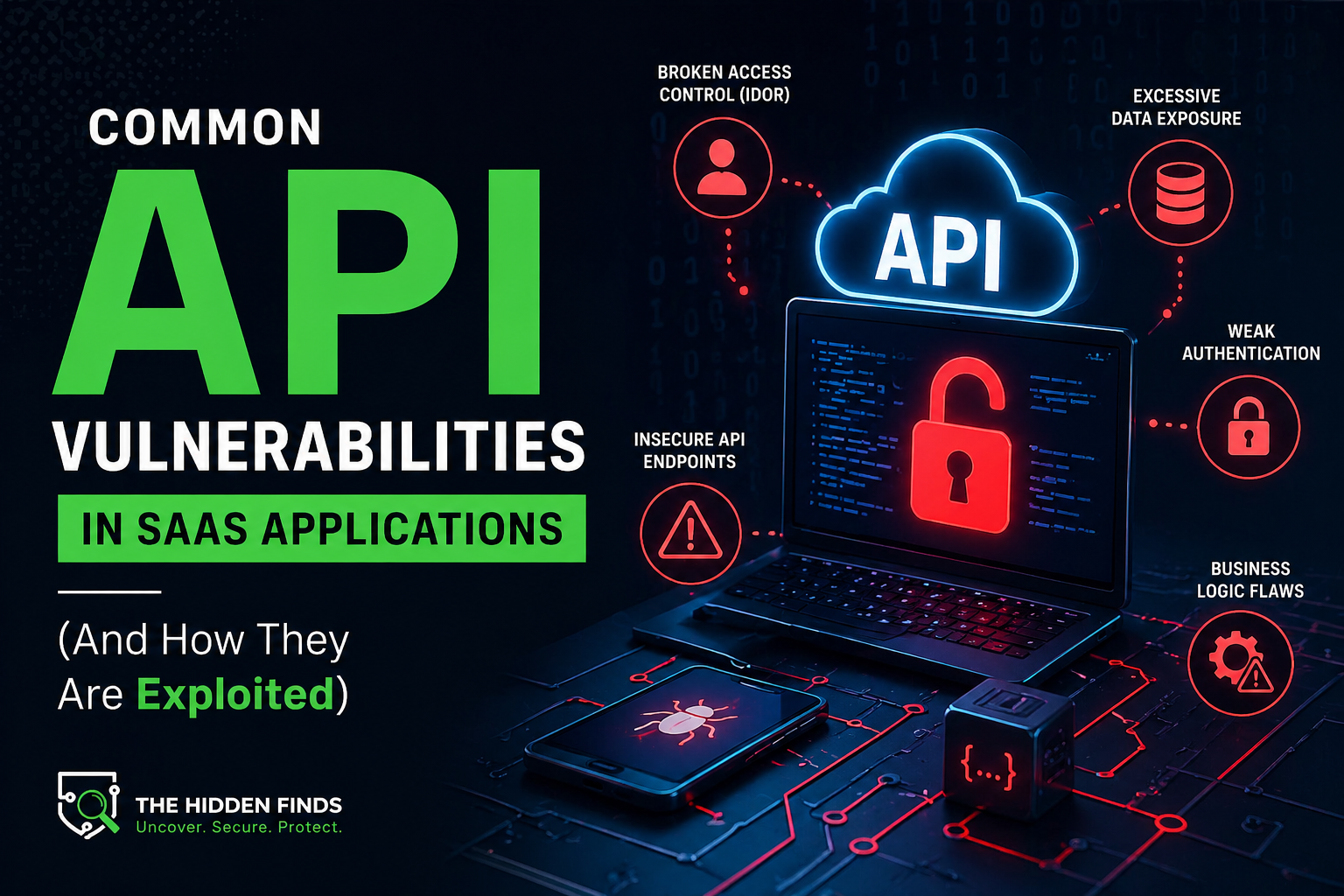
1. Broken Access Control
This is one of the most common and most dangerous API vulnerabilities.
The idea is simple.
An API trusts user input without verifying ownership.
For example:
GET /api/user/123
If the system does not check whether the logged-in user actually owns 123, an attacker can simply change it to:
GET /api/user/124
Now they’re accessing someone else’s data.
This is called:
- IDOR (Insecure Direct Object Reference)
- BOLA (Broken Object Level Authorization)
This type of issue is extremely common in SaaS dashboards, CRMs, and multi-tenant platforms.
2. Weak Authentication & Session Handling
Many SaaS applications rely on:
- Tokens
- Session IDs
- Cookies
But they often fail to handle them securely.
Common issues include:
- Tokens that never expire
- Reusable session tokens
- Missing validation checks
- Tokens exposed in frontend or local storage
An attacker can:
- Steal a token
- Replay it
- Access the account without needing credentials
Even worse — in some cases, password resets don’t invalidate old sessions.
Which means:
Changing your password doesn’t log the attacker out.
3. Excessive Data Exposure
APIs often return more data than necessary.
For example:
A simple request to fetch user profile data might return:
- Internal IDs
- Roles
- Permissions
- Hidden flags
Even if the frontend doesn’t display it. Attackers don’t care about what’s visible. They care about what’s returned.
This type of issue can lead to:
- Data leakage
- Internal system exposure
- Privilege escalation
4. Insecure API Endpoints
Some APIs are left:
- Unauthenticated
- Partially protected
- Hidden but accessible
Developers assume:
“No one knows this endpoint exists”
Attackers prove them wrong.
Using tools and simple enumeration techniques, attackers can:
- Discover hidden endpoints
- Test them directly
- Access internal functionality
This is especially common in:
- Admin APIs
- Internal tools
- Legacy endpoints
5. Business Logic Vulnerabilities
This is where things get interesting. Not all vulnerabilities are technical. Some are purely logical.
For example:
- Applying a discount multiple times
- Skipping payment steps
- Abusing referral systems
- Triggering actions out of order
The API technically works. But the workflow is broken. These issues are often missed by automated tools and require manual testing to uncover.
How Attackers Actually Exploit APIs
In most real-world cases, attackers don’t “hack” in the traditional sense.
They:
- Intercept API requests
- Modify parameters
- Replay requests
- Observe responses
- Chain weaknesses
That’s it.
No malware. No complex payloads. Just understanding how the system behaves.
Where Most SaaS Startups Fail
From practical testing experience, the biggest mistakes are:
- Trusting the frontend too much
- Not validating user access properly
- Overexposing API responses
- Ignoring business logic abuse
- Skipping proper security testing
Startups move fast. Security is often delayed. And APIs become the weakest link.
Why API Security Testing Matters
APIs are not just technical components. They are the core of your application. If they fail, everything fails.
Proper API security testing helps identify:
- Broken access control
- Authentication flaws
- Data exposure risks
- Business logic vulnerabilities
Before attackers do.
Final Thoughts
Most SaaS applications don’t get hacked because of advanced exploits. They get compromised because of simple, overlooked API flaws. Things that look harmless.
Things that “shouldn’t work” — but do.
Understanding how APIs can be abused is the first step toward building a secure system.
Need Help Testing Your APIs?
If you’re building a SaaS product or managing APIs, it’s important to understand how they behave under real-world attack scenarios.
At The Hidden Finds, we focus on identifying practical vulnerabilities in APIs, authentication systems, and application workflows — not just surface-level issues.
If you want to assess your application’s security, reach out and we’ll help you identify what actually matters.