
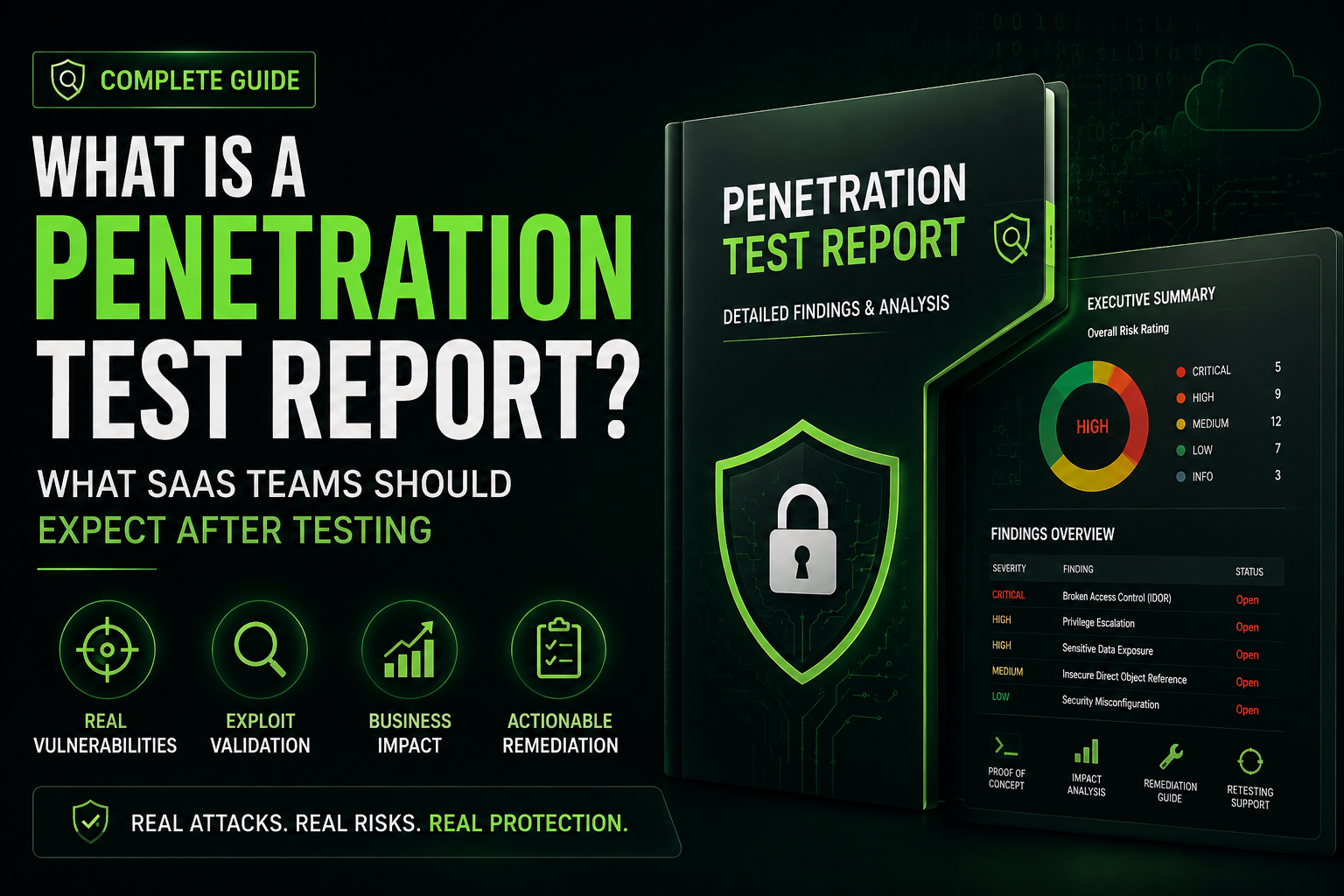
Most companies think the penetration test is the final deliverable.
It’s not.
The real value often comes after the testing is complete — inside the penetration test report itself.
Because a good penetration test report does more than list vulnerabilities. It explains how your application can actually be attacked, what business risk exists, how the issue was validated, and what your team should prioritize first.
Unfortunately, many SaaS companies only realize this after paying for a security assessment and receiving a report filled with automated scanner output, vague severity ratings, and generic remediation advice that nobody on the engineering team finds useful.
A penetration test report should not feel like compliance paperwork. It should help your team understand real risk.
And that difference matters more than most organizations realize.
Why the Penetration Test Report Matters More Than People Think
In modern SaaS environments, vulnerabilities are rarely isolated technical mistakes. They are often tied directly to how the application behaves, how permissions are handled, how APIs respond, or how workflows can be manipulated.
That means context is critical.
If a report simply says:
“Sensitive endpoint discovered”
that tells almost nothing about the actual risk.
But if the report explains:
“This API endpoint allows one authenticated tenant to access another tenant’s billing information through insecure object reference manipulation”
the engineering team immediately understands:
- what happened
- why it matters
- how serious the issue actually is
This is why the reporting process is just as important as the testing itself.
A weak report creates confusion.
A strong report creates action.
What a Professional Penetration Test Report Should Include
A proper penetration test report should always begin with an executive summary written in business language, not only technical language.
Leadership teams often review the report before engineers do. They need to understand:
- what was tested
- what level of risk was identified
- whether customer data or business operations were impacted
- what should be prioritized
This section should be clear, concise, and practical.
After that, the report should move into technical findings.
Each finding should include:
- a clear vulnerability title
- affected endpoints or functionality
- severity rating
- detailed reproduction steps
- proof of concept or evidence
- business impact
- remediation guidance
The reproduction steps are especially important.
Developers should be able to follow the report and understand exactly how the issue was validated. If the finding cannot be reproduced internally, fixing it becomes significantly harder.
This is one of the biggest problems with low-quality automated reports. They often generate alerts without proper validation, leaving internal teams wasting time chasing false positives or vague security concerns.
The Difference Between Automated Reports and Real Security Assessments
This is where many companies get misled.
Some providers advertise penetration testing, but the final deliverable is little more than exported scanner output with branding added on top.
These reports often contain:
- informational findings with little business impact
- duplicated issues
- missing exploit validation
- generic remediation advice
- no workflow or business logic analysis
The problem is that automated tools do not understand applications the way attackers do.
They cannot fully evaluate:
- broken access control
- IDOR vulnerabilities
- multi-step exploitation paths
- business logic abuse
- privilege escalation through workflows
- API authorization weaknesses
These are the issues that commonly lead to real breaches in SaaS applications.
And these are the findings that require manual testing and proper documentation.
A real penetration test report should demonstrate that the tester actually interacted with the application, understood how it behaves, and validated exploitability under realistic conditions.
Why SaaS Applications Require Better Reporting
SaaS applications introduce a different level of complexity compared to traditional websites.
Most modern SaaS platforms include:
- APIs
- authentication systems
- multi-tenant environments
- role-based access controls
- third-party integrations
- internal automation workflows
Because of this, the risk is often tied to relationships between components rather than isolated technical flaws.
For example, a vulnerability may only become dangerous when:
- combined with weak authorization
- chained with another API issue
- abused across tenant boundaries
- triggered through workflow manipulation
This means the report must explain not only the vulnerability itself, but also how it fits into the broader application environment.
Without that context, teams struggle to understand real-world impact.
What Developers Actually Want From a Pentest Report
Most engineering teams do not want a 100-page document filled with unnecessary noise.
They want clarity.
A useful penetration test report helps developers answer:
- What is vulnerable?
- How can it be exploited?
- What is the actual impact?
- How should it be fixed?
- What should be prioritized first?
Good reporting respects developer time.
The findings should be structured clearly, technically accurate, and actionable without becoming unnecessarily academic or overloaded with compliance language.
The best reports feel collaborative rather than performative.
Why Severity Ratings Alone Are Not Enough
One common mistake in penetration testing is over-reliance on CVSS scores or generic severity labels.
In practice, business impact matters more than numerical scoring.
For example:
- a “medium severity” IDOR vulnerability exposing customer financial data may be far more dangerous than a technically complex “high severity” issue with limited practical impact
This is why mature reporting focuses on exploitability and business context, not only technical classification.
The goal is not simply to assign numbers.
The goal is to help organizations reduce real risk.
Retesting Is Part of the Process
A proper penetration test does not end when the report is delivered.
After fixes are implemented, retesting is critical.
Many vulnerabilities appear resolved at first glance but remain exploitable due to incomplete remediation, overlooked edge cases, or inconsistent authorization checks across APIs and workflows.
Retesting validates whether the underlying issue was actually fixed instead of partially patched.
This step is often overlooked, but it plays a major role in improving long-term security posture.
What SaaS Teams Should Look for Before Hiring a Pentesting Provider
Before choosing a penetration testing provider, SaaS teams should understand what type of testing they are actually paying for.
Some important questions include:
- Is the testing manual or mostly automated?
- Will APIs and business logic be tested?
- Will exploitability be validated?
- Does the provider understand SaaS environments?
- Is retesting included?
- What does the final report actually look like?
Asking these questions early helps avoid low-value assessments that produce little actionable insight.
Because ultimately, the quality of the report often reflects the quality of the testing behind it.
Final Thoughts
A penetration test report should not exist simply to satisfy compliance requirements or check a security box.
It should help your team understand how attackers actually view your application.
The best reports create clarity. They explain real exploit paths, provide actionable remediation guidance, and help organizations prioritize what truly matters.
In modern SaaS applications, where APIs, authentication systems, and business workflows create increasingly complex attack surfaces, that level of clarity is essential.
Because the real value of penetration testing is not the number of findings in a report.
It is understanding which vulnerabilities can actually become incidents.
Need Help Testing Your SaaS Application?
At The Hidden Finds, the focus is on practical penetration testing for modern SaaS applications, APIs, and authentication systems.
The goal is not to generate automated reports filled with noise, but to identify real, exploitable vulnerabilities that impact security and business risk.
If you want a practical security assessment that focuses on real-world attack paths and actionable findings, reach out with details about your application and testing scope.