
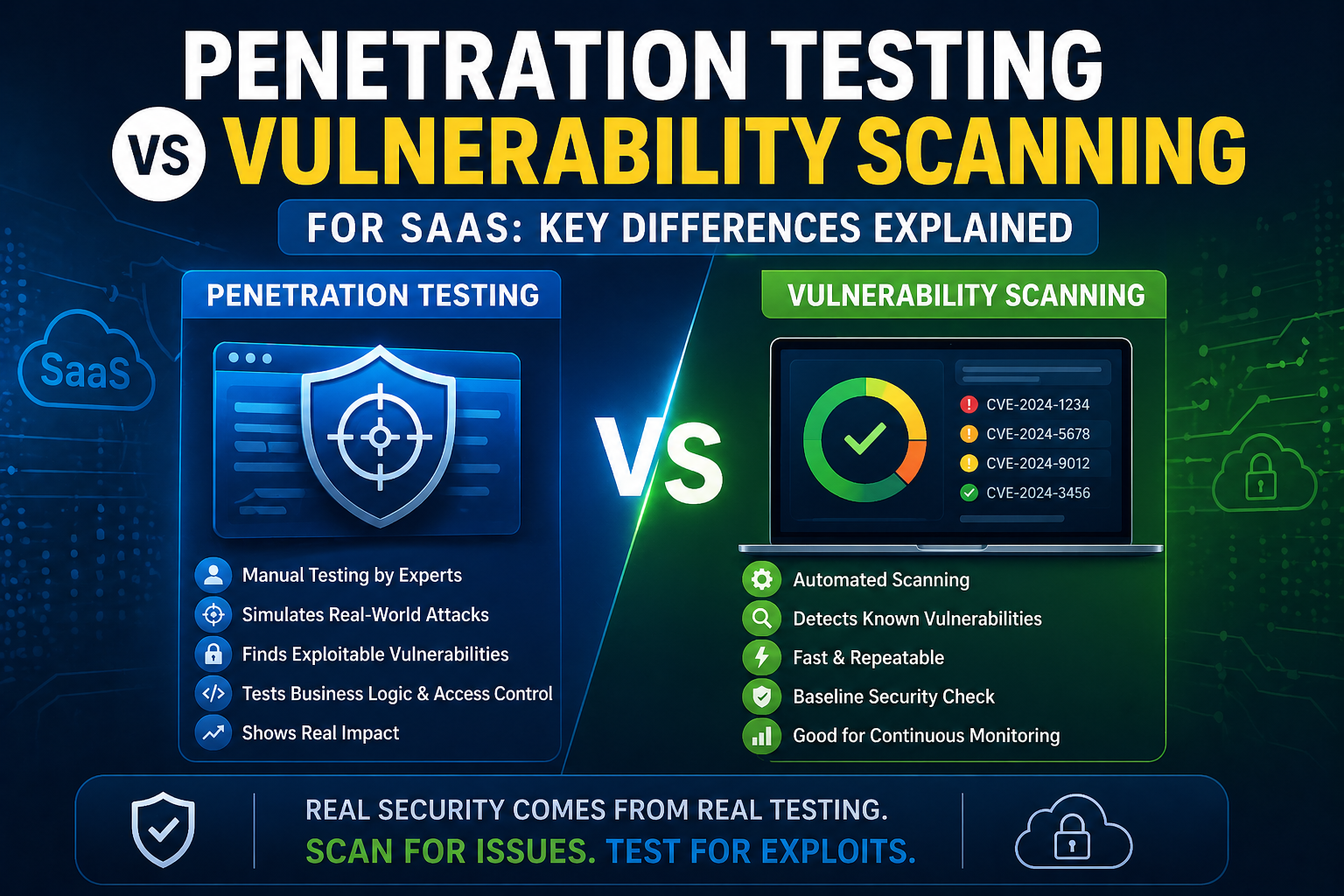
If you’re building a SaaS product or managing a web application, you’ve probably come across both terms: penetration testing and vulnerability scanning. They’re often used interchangeably, but in reality, they solve very different problems. Understanding that difference is critical, because choosing the wrong approach can leave real vulnerabilities completely unnoticed.
Vulnerability scanning is an automated process that uses tools to identify known security issues in your application, APIs, or infrastructure. These tools check for outdated software, known CVEs, misconfigurations, and common weaknesses that can be detected through predefined rules. It is fast, repeatable, and useful for maintaining a baseline level of security across systems. However, it has a fundamental limitation. It can only detect what it has been programmed to detect. It does not understand how your application behaves in real-world scenarios, nor can it evaluate how different components interact within complex workflows.
Penetration testing, on the other hand, is a manual security assessment that simulates real-world attacks against your application. Instead of simply scanning for known issues, it involves actively interacting with the system to identify how it can be abused. This includes analyzing authentication flows, testing access control logic, evaluating API behavior, and exploring business workflows. Through this process, testers uncover vulnerabilities such as broken access control (IDOR/BOLA), authentication flaws, business logic abuse, and sensitive data exposure. These are the same types of issues that often lead to account takeovers, data breaches, and unauthorized access in real-world environments.
The core difference between the two comes down to detection versus exploitation. Vulnerability scanning highlights potential issues, while penetration testing validates whether those issues can actually be exploited. A scanner might indicate that an endpoint exists or accepts input, but a penetration test will demonstrate whether that endpoint can be used to access another user’s data or bypass authentication. That distinction is what separates theoretical risk from actual business impact.
Relying solely on vulnerability scanning is not enough, especially in modern SaaS environments. Today’s applications are built around APIs, authentication systems, role-based access controls, and complex user workflows. Automated tools struggle to fully understand these systems. They cannot identify IDOR vulnerabilities, abuse business logic, chain multiple weaknesses together, or think like an attacker. This is why many real-world breaches occur even when organizations believe their systems are secure based on scan results.
That said, vulnerability scanning still plays an important role. It is valuable for continuous monitoring, quickly identifying known issues, maintaining security hygiene, and supporting an overall vulnerability management process. It serves as a baseline layer of security, but it should not be mistaken for a complete security assessment.
Penetration testing becomes essential when you need to understand how your system behaves under real attack conditions. This is particularly important when launching or scaling a SaaS product, handling sensitive user data, or relying heavily on APIs and complex workflows. A proper penetration test does more than list issues. It validates exploitability, demonstrates real attack paths, and provides actionable insights that help teams fix what actually matters.
Another common point of confusion is the difference between vulnerability assessment and penetration testing. A vulnerability assessment focuses on identifying and prioritizing weaknesses, while penetration testing actively attempts to exploit them. In practice, both are useful, but penetration testing provides a clearer picture of real risk because it reflects how attackers actually operate.
In SaaS environments, the most critical vulnerabilities are rarely simple or obvious. They often involve logic flaws, access control issues, API misuse, and authentication weaknesses. These are not easily detected by automated tools, yet they are exactly what attackers target. This is why relying on scanning alone creates a false sense of security.
Ultimately, the question is not whether your system has vulnerabilities. Every system does. The real question is whether those vulnerabilities can be exploited in a meaningful way. Penetration testing answers that question, which is why it remains one of the most effective ways to understand real security risk.
If you’re building or scaling a SaaS application and want to identify real vulnerabilities before attackers do, a practical approach to security testing is essential. At The Hidden Finds, the focus is on manual penetration testing for SaaS platforms, APIs, and modern web applications. The goal is not to generate automated reports, but to uncover real, exploitable weaknesses that impact your business.