
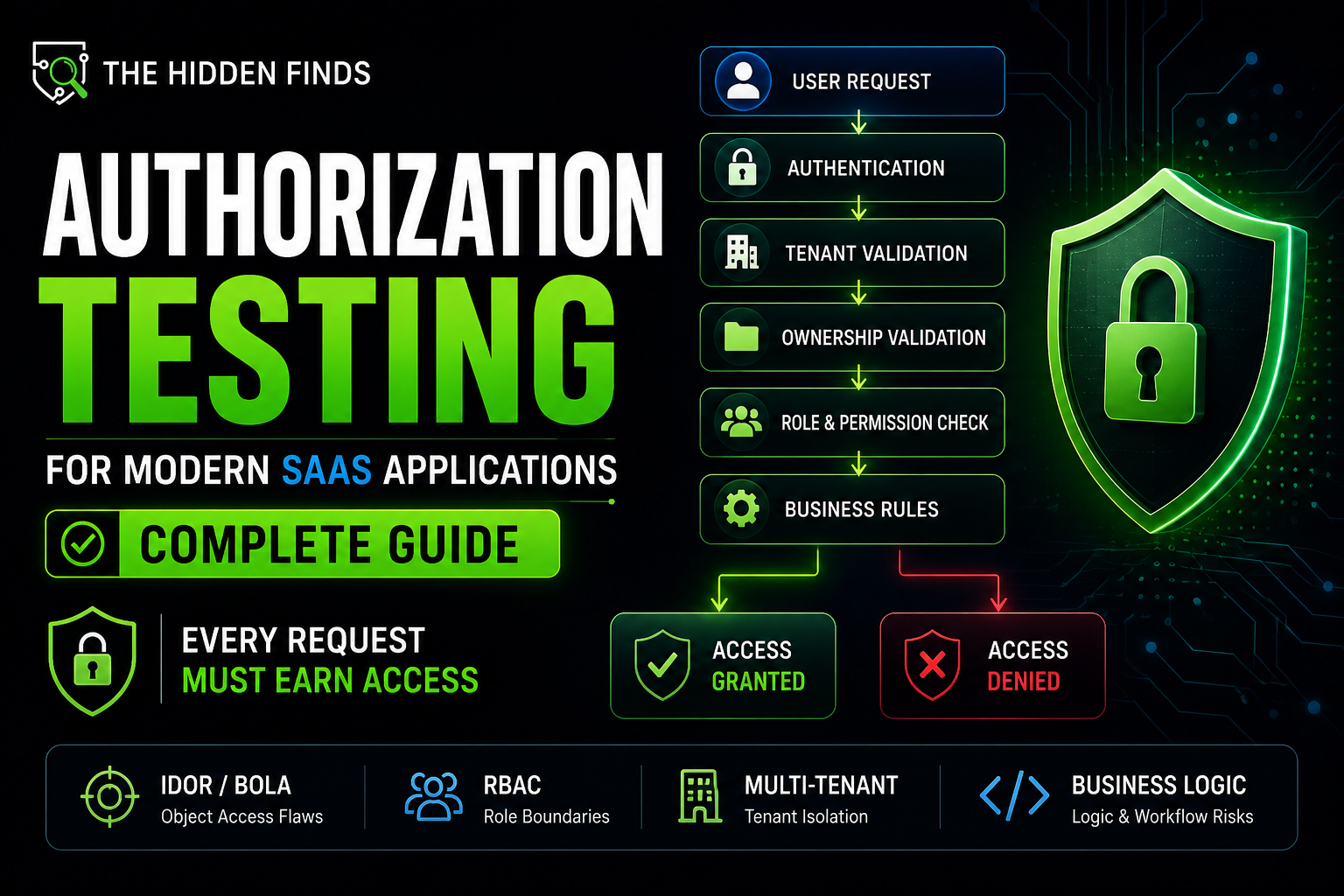
Learn how modern SaaS teams evaluate authorization, role boundaries, tenant isolation, object ownership, and business logic to identify security weaknesses before they become production incidents.
Modern SaaS applications are designed to handle some of an organization’s most valuable assets. Customer records, invoices, source code, financial information, healthcare data, internal documentation, AI workflows, and administrative controls are now accessed entirely through web applications and APIs. As these platforms continue to grow in complexity, securing them has become significantly more challenging than simply protecting login pages or enforcing strong passwords.
One of the most important responsibilities of any SaaS application is ensuring that every user can access only the information and functionality they are explicitly permitted to use. Whether someone is viewing a project, exporting customer data, changing billing information, or inviting a new team member, the application must make hundreds of authorization decisions every day. Those decisions determine whether sensitive information remains protected or becomes exposed to the wrong person.
Authentication vs. Authorization: Understanding the Difference
Authentication and authorization are often mentioned together, but they solve two very different security problems. Understanding that distinction is essential before discussing authorization testing.
Authentication answers one simple question:
Who is this user?
When someone signs in using an email address, password, passkey, or single sign-on provider, the application verifies their identity and establishes a trusted session. Once this process is complete, the application knows who the user is.
Authorization begins where authentication ends.
Instead of asking who the user is, authorization asks:
What is this authenticated user allowed to do?
This difference may appear subtle, but it is one of the most important concepts in application security.
Imagine two employees working for different companies that both use the same project management platform. Both users successfully authenticate and access the application using valid credentials. From an authentication perspective, everything is working exactly as intended.
However, authentication alone does not determine whether either employee should be able to access another company’s projects, invoices, uploaded documents, or customer records.
Every request must still answer several important questions before access is granted.
- Does this project belong to the user’s organization?
- Is this user allowed to edit rather than simply view it?
- Has the project already been archived?
- Does the user’s subscription plan permit this action?
- Is additional approval required before the operation can continue?
Only after these questions have been answered should the application decide whether to allow or deny the request.
This is authorization.
Many organizations invest heavily in securing authentication by implementing multi-factor authentication, strong password policies, or enterprise identity providers. While these controls are extremely important, they protect only the first step of the user’s journey.
Once a legitimate user has successfully signed in, authorization becomes the primary security control protecting every piece of sensitive functionality inside the application.
Why Authorization Is So Difficult in Modern SaaS Applications
Authorization was relatively straightforward when applications consisted of a few users sharing a small number of features. Modern SaaS platforms are very different.
Today’s applications support multiple organizations, complex permission models, delegated administration, subscription tiers, third-party integrations, APIs, mobile clients, AI workflows, and background services—all interacting with the same underlying data.
Every new feature introduces additional authorization decisions.
A customer support representative may be allowed to view customer accounts but not billing information. A finance administrator may export invoices but not modify user permissions. Project managers may invite new members to their own workspace but should never gain administrative access to another organization’s environment.
These rules are rarely enforced by a single permission check.
Instead, every sensitive request often depends on several layers of validation working together.
The application may need to verify:
- the user’s identity,
- their assigned role,
- tenant or organization membership,
- ownership of the requested object,
- workflow state,
- subscription or licensing restrictions,
- and other business-specific rules.
Missing only one of these validations can create an authorization vulnerability.
This is why broken access control continues to appear among the most serious security risks affecting modern web applications. The challenge is not implementing one permission check—it is consistently applying hundreds of authorization decisions across an application that continues to evolve.
Authorization Is a Business Decision, Not Just a Technical Check
One of the biggest misconceptions about authorization is that it is simply another technical security control.
In reality, authorization reflects the business rules of the application itself.
Consider a SaaS accounting platform.
The application doesn’t simply need to verify that someone is logged in. It also needs to understand questions such as:
- Which company owns this invoice?
- Has the invoice already been approved?
- Is the user part of the finance department?
- Does the user’s role permit editing rather than viewing?
- Is this organization allowed to export financial records under its current subscription?
These questions have nothing to do with HTTP requests or programming frameworks. They are business decisions that happen to be enforced through software.
Because every SaaS product has its own workflows, customer models, approval processes, and permission structures, authorization cannot be treated as a one-size-fits-all problem.
This is one of the reasons manual authorization testing remains so valuable. Before testing whether permissions are correctly enforced, a reviewer must first understand how the application is intended to behave.
Good Authorization Is About Making the Right Decision
One of the biggest misconceptions about access control is that its purpose is simply to block requests.
In reality, good authorization is about making the correct decision every time a user attempts to interact with the application.
Sometimes that decision should allow access.
Sometimes it should deny access.
In many situations, however, the answer depends on several factors working together. The application may need to consider the user’s role, the organization they belong to, who owns the requested resource, the current workflow state, subscription limits, and other business-specific rules before deciding whether the action should be permitted.
Strong authorization is therefore not measured by how often requests are rejected. It is measured by how consistently the application reaches the correct decision regardless of which interface, endpoint, or workflow the request follows.Consultant Insight
One of the most common misconceptions is that authorization vulnerabilities exist because developers ignore security.
In our experience, the opposite is often true.
Modern SaaS applications contain hundreds of interconnected APIs, workflows, background jobs, integrations, and permission combinations. As products grow, keeping every authorization decision perfectly consistent becomes increasingly difficult.
Many high-impact authorization flaws arise not from a complete lack of security controls, but from a single overlooked endpoint, workflow, or API that behaves differently from the rest of the application.
That is precisely why authorization testing focuses on understanding how the entire system works—not just how individual endpoints respond.
User Request
│
▼
Authentication
│
▼
Tenant Validation
│
▼
Ownership Validation
│
▼
Role & Permission Check
│
▼
Business Rules
│
▼
Access Granted / Denied
The Most Common Authorization Vulnerabilities in SaaS Applications
Authorization vulnerabilities rarely appear because an application has no security controls. More often, they emerge because one part of the application enforces a rule correctly while another part unintentionally bypasses it.
As SaaS platforms evolve, new APIs are introduced, workflows become more complex, mobile applications are released, and third-party integrations are added. Each of these changes introduces additional authorization decisions that must remain consistent with the rest of the system. When even a single endpoint behaves differently, the result can be a serious security issue.
One of the most well-known examples is Insecure Direct Object Reference (IDOR), also known in API security as Broken Object Level Authorization (BOLA). These vulnerabilities occur when an application accepts a reference to an object—such as a project, invoice, document, or customer record—but fails to verify that the requesting user is actually authorized to access it.
Authorization weaknesses are not limited to object ownership. They also appear as privilege escalation issues, tenant isolation failures, inconsistent role enforcement, insecure export functionality, GraphQL resolver authorization mistakes, and business logic flaws where users are allowed to perform actions outside the intended workflow.
Although these vulnerabilities appear different on the surface, they often share the same underlying cause: the application makes an incorrect authorization decision.
How Professional Authorization Testing Works
Unlike many other areas of application security, authorization testing begins long before individual requests are examined.
The first objective is understanding how the application is supposed to behave.
Professional reviewers spend time identifying the application’s trust boundaries, user roles, organizational structure, ownership rules, and business workflows before attempting to verify whether those rules are consistently enforced.
Rather than approaching an application as a collection of independent endpoints, they view it as an interconnected system where every authorization decision influences another.
A typical assessment begins by mapping the application’s permission model.
Questions such as these become the foundation of the review:
During this discovery phase, reviewers identify every user role within the application, determine which resources belong to individual users or organizations, understand where administrative privileges begin, and map the workflows that change permissions over time. Building this picture first allows the remainder of the assessment to focus on verifying that the application’s access-control model is enforced consistently across every feature.
Once these relationships are understood, reviewers begin validating whether every interface—web application, REST API, GraphQL endpoint, mobile client, background process, and administrative workflow—enforces those same rules consistently.
The objective is not simply to discover vulnerabilities. It is to verify that the application’s authorization model behaves predictably regardless of how users interact with the platform.
Where Authorization Usually Breaks Down
Authorization weaknesses rarely appear because an application has no security controls. In many cases, the application already contains a well-designed permission model, but one part of the system gradually falls out of sync with the rest.
A feature introduced for the mobile application may enforce permissions differently from the web interface. A GraphQL mutation may correctly validate ownership while the equivalent REST endpoint does not. An export feature may verify that a user is authenticated but forget to confirm they belong to the correct organization. Even background jobs, integrations, and administrative tools can unintentionally bypass checks that exist elsewhere in the application.
These inconsistencies become more common as SaaS platforms grow. Every new feature, API, integration, or workflow introduces additional authorization decisions that need to remain aligned with the application’s original security model.
This is why authorization testing focuses on understanding the entire system rather than evaluating isolated requests. The objective is not simply to discover missing permission checks—it is to verify that the application’s security decisions remain consistent across every path a user can take.
Why Automated Security Tools Are Not Enough
Automated security scanners remain an important part of every mature security program. They provide excellent coverage for known vulnerabilities, configuration issues, outdated software, missing security headers, and many common implementation mistakes.
However, authorization testing presents a fundamentally different challenge.
A scanner cannot determine who owns invoice #4821, whether a user should have permission to approve refunds, or whether a project belongs to the current organization. Those decisions depend on business context rather than technical signatures.
Imagine two authenticated users belonging to different organizations inside the same SaaS platform. From a scanner’s perspective, both users appear valid. The scanner cannot automatically understand that each user should only access their own organization’s data unless it first understands the application’s permission model.
Effective authorization testing requires context.
Consider a project management platform used by hundreds of companies.
Each customer has its own users, projects, files, invoices, and administrative settings. From a technical perspective, every request may appear valid because the user is authenticated. The real challenge is determining whether that user should be allowed to access the specific resource being requested.
A professional reviewer therefore looks beyond the request itself and evaluates the relationships behind it. Does the project belong to the user’s organization? Is the requested action appropriate for their role? Has ownership changed during a workflow? Are the same permission checks enforced across the API, mobile application, and administrative interface?
These are questions that require an understanding of the application’s business logic rather than simply analysing individual HTTP requests.
It requires understanding how the product works, how customers interact with it, how permissions change over time, and how business rules influence security decisions.
Automation and manual testing should never be viewed as competing approaches. They solve different problems.
Automated tools improve coverage, consistency, and speed.
Manual testing provides context, judgement, and validation.
Organizations that combine both approaches generally achieve a much more complete understanding of their security posture than those relying exclusively on either one.
While every SaaS application implements authorization differently, there are several practical questions every engineering team should be able to answer before releasing new functionality.
Questions Every SaaS Team Should Ask Before Releasing
Before every production release, engineering teams should take a moment to consider a few practical questions.
If a customer modifies an identifier in a request, could they accidentally—or intentionally—access another customer’s information?
If a user accepts an invitation today, what permissions will they have tomorrow if their role changes?
If the frontend hides an administrative action, what happens when the same request is sent directly to the API?
If a customer exports sensitive information, are exactly the same authorization checks enforced across every interface?
If ownership changes during a workflow, does the authorization model change with it?
These questions may appear simple, but they reflect the kinds of scenarios that frequently uncover authorization weaknesses during professional security assessments. Asking them during development is significantly less expensive than answering them after a production incident.
Final Thoughts
Authorization is one of the foundations of modern SaaS security. Every authenticated request represents a decision about trust, ownership, permissions, and business rules. As applications become more sophisticated, those decisions become increasingly difficult to enforce consistently across APIs, GraphQL endpoints, administrative interfaces, mobile applications, and complex workflows.
Strong authorization is not achieved by adding more permission checks. It is achieved by ensuring that every part of the application reaches the same security decision under every legitimate user journey.
Automated scanners remain invaluable for identifying many technical weaknesses, but they cannot fully understand how your product is designed to operate. Manual authorization testing provides that missing perspective by evaluating real business workflows, tenant boundaries, ownership relationships, and permission models in the context of how customers actually use the application.
The strongest security programs recognize the value of both. Automation provides speed and broad coverage. Manual testing adds experience, context, and critical thinking. Together, they help organizations identify high-impact authorization vulnerabilities before they become security incidents.
Continue Your Authorization Security Journey
If you’re reviewing or improving the security of a SaaS application, these additional resources may also be helpful:
- IDOR Vulnerabilities Explained: How Attackers Access Other Users’ Data
- Broken Access Control: Why It Remains One of the Most Dangerous Application Security Risks
- API Security Checklist for SaaS Teams
- Access Control Testing Checklist
- Sample Access Control Security Assessment Report
Exploring these resources alongside this guide will provide a more complete understanding of how authorization failures occur and how they can be identified before they affect production systems.
Need an Independent Authorization Review?
Authorization vulnerabilities are often among the most impactful issues identified during SaaS security assessments because they are closely tied to the way a product is designed and operated.
If you’re preparing for a major release, introducing new APIs, redesigning your permission model, or simply want confidence that your authorization controls are working as intended, an independent manual review can provide valuable insight into areas that automated tools are not designed to evaluate.
At The Hidden Finds, we specialize in manual SaaS application security assessments with a strong focus on authorization, API security, access control, business logic, multi-tenant architectures, GraphQL, and AI-powered workflows. Our objective is not simply to identify vulnerabilities, but to help engineering teams understand how those vulnerabilities arise and how they can be addressed in a practical, risk-based manner.