
Understanding one of the most common and dangerous security flaws affecting modern SaaS applications.
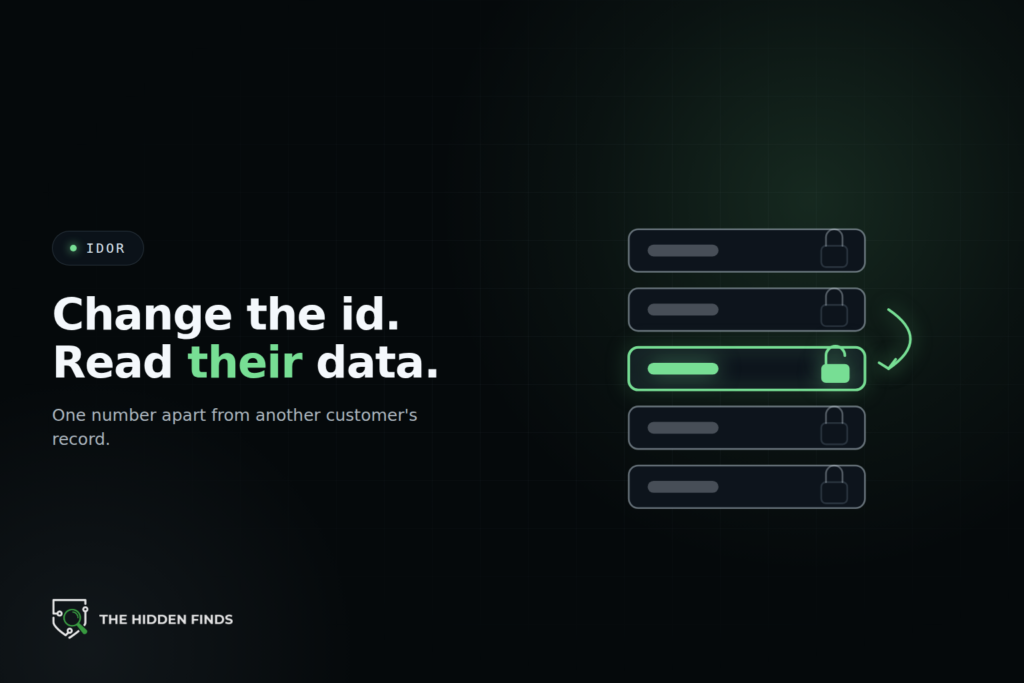
Modern SaaS applications are built around one simple idea: users should only be able to access the data and functionality they are authorized to use. Customers trust these platforms with invoices, customer records, financial information, source code, medical records, and countless other forms of sensitive data. That trust depends on one critical security control: proper authorization.
Unfortunately, many applications get this wrong.
One of the most common examples is an Insecure Direct Object Reference (IDOR) vulnerability. Although the name may sound technical, the concept is surprisingly simple. An application exposes a reference to an internal object (such as a user account, document, order, project, or invoice) and fails to verify whether the person requesting that object actually has permission to access it.
This small oversight has been responsible for some of the most serious data exposure incidents in modern web applications. Even mature SaaS platforms have occasionally suffered from authorization flaws that allowed attackers to view, modify, or delete information belonging to other users.
Understanding how IDOR vulnerabilities occur is essential for anyone building or securing modern applications.
What Is an IDOR Vulnerability?
An IDOR vulnerability occurs when an application uses user-controlled identifiers to retrieve data without performing proper authorization checks.
Consider a simple example. A user logs into a project management platform and views one of their projects using a URL similar to:
/projects/4521
The application correctly returns the project because the user owns it.
However, imagine the user changes the URL to:
/projects/4522
If the application returns another customer’s project without verifying ownership, an attacker has successfully accessed data they should never have been able to see.
The vulnerability is not that the identifier is predictable. The real issue is that the server trusted the request without confirming that the authenticated user was actually authorized to access the requested resource.
This distinction is important because many development teams spend time making identifiers harder to guess while overlooking the authorization logic itself. Random identifiers may slow attackers down, but they do not replace proper access control.
Why IDOR Vulnerabilities Are So Dangerous
Unlike many technical vulnerabilities that require complex exploitation, IDOR vulnerabilities often involve nothing more than changing a number, modifying a parameter, or replacing an identifier inside an API request.
When authorization checks are missing, attackers can sometimes retrieve sensitive information within seconds.
Depending on the application, an attacker may gain access to customer profiles, invoices, uploaded documents, payment history, support tickets, medical records, internal messages, or administrative resources. In more severe cases, the vulnerability allows attackers to modify or delete another user’s data rather than simply viewing it.
Because the application behaves exactly as designed, traditional security monitoring may not immediately recognize the activity as malicious. To the server, the request often appears completely legitimate.
Why SaaS Applications Are Especially Vulnerable
Modern SaaS platforms expose hundreds of API endpoints that exchange data between browsers, mobile applications, and backend services. Every endpoint that references a resource (whether it is a project, organization, user profile, subscription, invoice, or document) becomes a potential authorization decision.
As products grow, development teams frequently focus on adding features, improving performance, and supporting new customer workflows. Authorization logic becomes distributed across many services, making it increasingly difficult to ensure every endpoint consistently verifies ownership.
Multi-tenant architectures introduce additional complexity. A user may legitimately belong to several organizations, hold different roles, or collaborate across multiple workspaces. These legitimate business requirements create situations where a small authorization mistake can accidentally expose data belonging to an entirely different customer.
This is one reason access control remains one of the most common causes of serious SaaS security incidents.
How Attackers Discover IDOR Vulnerabilities
Attackers rarely begin by randomly guessing identifiers. Instead, they first map how the application references data.
During this process they observe URLs, API requests, GraphQL queries, hidden parameters, file downloads, mobile traffic, and background requests generated by the application. They look for patterns that reveal how resources are identified internally.
Once these identifiers are understood, attackers begin testing whether the application validates ownership before returning data.
For example, they may replace one project ID with another, modify an organization identifier, substitute a different user ID inside an API request, or replay legitimate requests using values that belong to another account.
The objective is not simply to retrieve different information. It is to determine whether the server performs authorization every time a protected resource is requested.
APIs Have Made IDOR More Common
While IDOR vulnerabilities existed long before APIs became popular, today’s API-driven applications have significantly increased the number of potential attack surfaces.
Single-page applications, mobile apps, GraphQL endpoints, and REST APIs all rely heavily on object identifiers to exchange information between clients and servers.
Every endpoint that retrieves customer-specific data represents another opportunity for authorization mistakes.
In API security the same flaw has its own name, Broken Object Level Authorization or BOLA, and it sits first in the OWASP API Security Top 10.
This is why API security assessments place so much emphasis on authorization testing. A secure authentication system alone is not enough. Even perfectly authenticated users should only be able to access resources they are explicitly permitted to use.
How Developers Can Prevent IDOR Vulnerabilities
Preventing IDOR vulnerabilities begins with a simple principle: every request must be authorized on the server.
Applications should never assume that because a user is authenticated, they are automatically authorized to access any resource they request.
Each request should verify ownership, organizational membership, assigned roles, and any additional business rules before returning sensitive data. Authorization decisions should be enforced consistently across web applications, mobile applications, APIs, GraphQL endpoints, and background services.
Using unpredictable identifiers can provide an additional layer of protection, but they should never replace proper authorization logic. Security must always be based on verifying permissions rather than hiding resource identifiers.
In practice, that comes down to a few specific habits:
- Scope every query to the owner. Fetch with
WHERE id = ? AND tenant_id = ?, taking the tenant from the authenticated session, rather than fetching by ID and checking ownership afterwards, where one missed check leaks data. - Take the user and tenant from the session, never from a parameter the client sends.
- Put the authorization check in one shared place that every endpoint calls, so a new endpoint cannot forget it.
- Deny by default. An endpoint returns nothing until a rule explicitly allows access.
- Test with two accounts. Create an object as user A, then try to read, update and delete it as user B, and repeat with a second tenant. Anything other than a refusal is an IDOR.
Why Automated Scanners Often Miss IDOR Vulnerabilities
One of the biggest misconceptions in application security is that automated vulnerability scanners can reliably identify authorization flaws.
Most scanners are excellent at detecting outdated software, missing security headers, known CVEs, and configuration issues. However, they struggle to understand how individual users should interact with business workflows.
Determining whether one customer should be able to access another customer’s invoice requires context that automated tools generally do not possess.
As a result, many IDOR vulnerabilities are discovered only through manual penetration testing, where testers deliberately evaluate authorization decisions across different accounts, roles, and organizations.
This is one reason broken access control has remained at the top of the OWASP Top 10 despite significant improvements in other areas of application security.
Why This Matters for SaaS Companies
For SaaS providers, customer trust depends on strong tenant isolation and reliable access control. Clients expect that their information remains private regardless of how many other organizations use the platform.
An IDOR vulnerability breaks that trust almost immediately.
Even a single exposed API endpoint can allow unauthorized access to confidential business information, potentially leading to regulatory consequences, contractual issues, financial losses, and long-term reputational damage.
Because these vulnerabilities often arise from business logic rather than technical misconfigurations, they require security testing that focuses on how the application actually behaves in real-world scenarios.
Final Thoughts
IDOR vulnerabilities are not caused by sophisticated hacking techniques. They occur because applications fail to answer one simple question before returning sensitive information:
“Is this user actually allowed to access this resource?”
Every protected object should require an authorization decision, regardless of how predictable or unpredictable its identifier may be.
For organizations building SaaS platforms, APIs, and modern web applications, consistently enforcing access control remains one of the most effective ways to prevent unauthorized data exposure.
At The Hidden Finds, I specialize in manual penetration testing for SaaS platforms, APIs, authentication systems, and business logic. Rather than relying solely on automated scanners, I evaluate how applications behave under real-world attack scenarios to identify vulnerabilities that can lead to unauthorized access and data exposure before attackers discover them.
Frequently Asked Questions
What is an IDOR vulnerability?
An insecure direct object reference is a flaw where an application uses an identifier from the request, such as a record ID, to fetch data without checking that the requesting user is allowed to access it. Changing the ID returns someone else’s data.
Is IDOR the same as BOLA?
Essentially, yes. BOLA, broken object level authorization, is the name the OWASP API Security Top 10 uses for the same flaw in APIs. Both describe a missing ownership check on an individual object.
Do random or UUID identifiers prevent IDOR?
No. Unpredictable IDs make objects harder to guess, but they still leak through URLs, logs, shared links and other API responses. The fix is an authorization check on every request, not a harder to guess identifier.
How do you test for IDOR?
Use two accounts. Create an object as one user, then try to read, update and delete it as the other, and repeat across two tenants. Any response other than a refusal is a finding.