
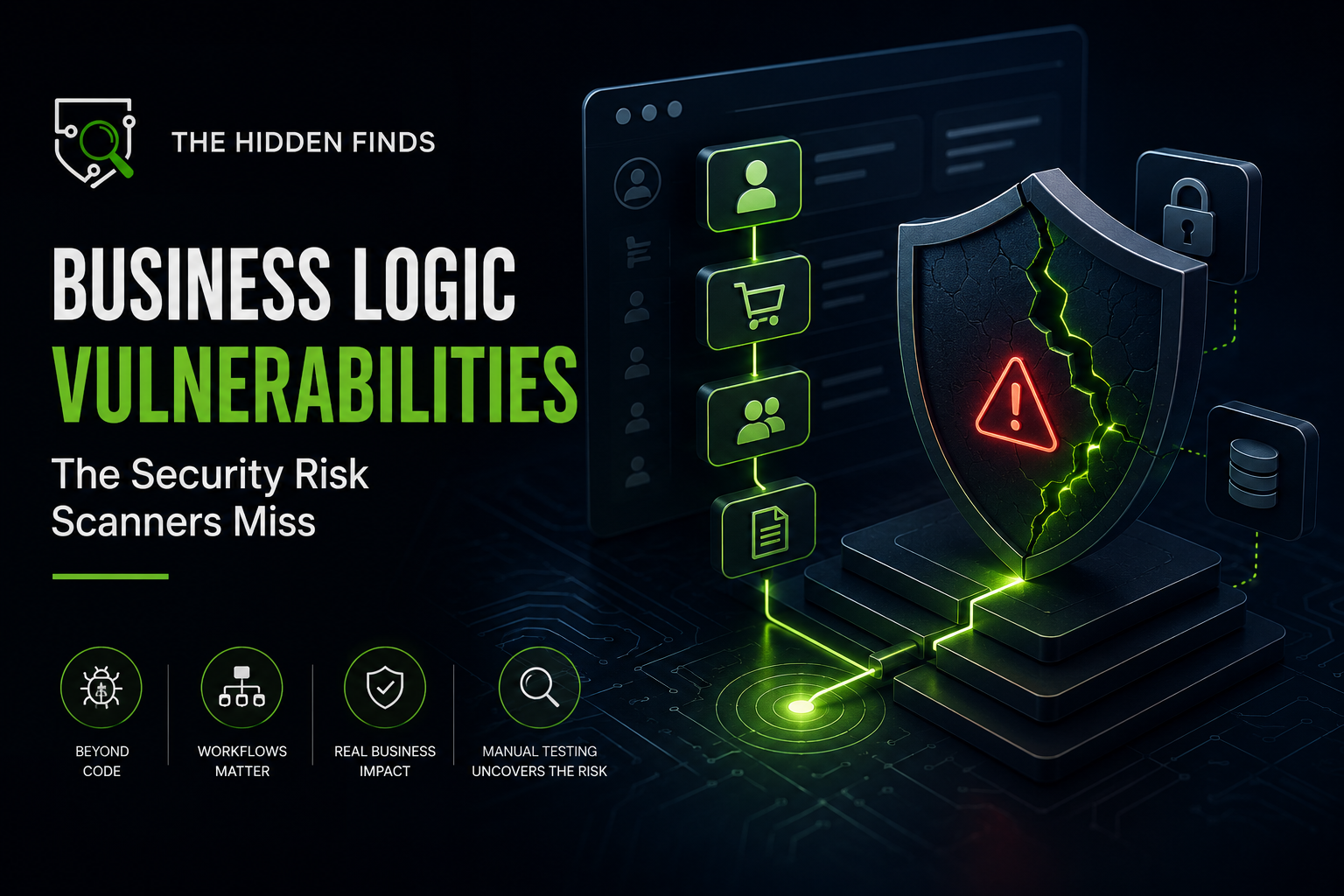
Modern SaaS applications are built around business processes rather than simple web pages. Users create projects, invite teammates, purchase subscriptions, approve invoices, generate reports, and collaborate across organizations. Every one of these actions follows a set of business rules that determine what should and should not happen.
Most security discussions focus on familiar vulnerabilities like SQL Injection, Cross-Site Scripting (XSS), or authentication flaws. While these remain important, some of the most damaging security issues found in SaaS applications have nothing to do with broken code. Instead, they occur because the application allows users to perform actions that violate its intended business rules.
These issues are known as business logic vulnerabilities.
Unlike traditional vulnerabilities, business logic flaws don’t usually involve malicious payloads or software bugs. The application often behaves exactly as it was programmed to behave—but not as the business intended. A workflow may allow actions in the wrong order, fail to enforce approval requirements, or overlook restrictions that should prevent sensitive operations. From a technical perspective, every request may appear valid. From a business perspective, the application’s decision-making has failed.
Why They Are So Difficult to Detect
Business logic vulnerabilities are challenging because there is no universal rulebook. Every SaaS product has its own workflows, permission models, subscription rules, customer journeys, and approval processes.
An automated scanner can quickly identify missing security headers or outdated software libraries because those issues follow well-defined patterns. It cannot determine whether a project should be editable after it has been approved, whether a customer should be allowed to downgrade a subscription while retaining premium features, or whether an invited user should have access to resources before accepting an invitation.
Answering those questions requires understanding how the application is supposed to work.
That is why many business logic flaws remain undiscovered until a manual security review is performed.
Where Business Logic Vulnerabilities Commonly Appear
Business logic vulnerabilities can exist anywhere an application makes decisions based on workflows rather than technical controls.
Some of the most common areas include approval processes, subscription and billing systems, account recovery, role changes, invitation workflows, document sharing, AI-powered automation, and multi-tenant collaboration features.
Individually, each workflow may seem straightforward. Combined, they create hundreds of possible user interactions that developers rarely have time to test from an attacker’s perspective.
As SaaS applications grow, these hidden interactions become one of the largest sources of security risk.
Why Manual Testing Still Matters
Modern security tools are incredibly valuable and should be part of every secure development process. They quickly identify known weaknesses, automate repetitive checks, and improve overall security hygiene.
However, business logic testing requires something automation cannot provide: context.
An experienced security reviewer begins by understanding how a feature is intended to operate. They examine user roles, workflow states, ownership rules, tenant boundaries, and business objectives before evaluating whether those rules can be manipulated in unexpected ways.
Rather than asking, “Is this endpoint vulnerable?”, the more important question becomes, “Should this action be possible at all?”
That shift in perspective often uncovers issues that automated testing simply cannot recognize.
Why It Matters for SaaS Teams
Business logic vulnerabilities rarely generate obvious error messages or system crashes. Instead, they quietly undermine trust by allowing users to perform actions the application should never permit.
For SaaS companies, these issues can lead to unauthorized access, workflow abuse, financial loss, incorrect permissions, tenant isolation failures, and unexpected exposure of customer data. More importantly, they can damage customer confidence even when the underlying infrastructure remains technically secure.
Security is no longer just about protecting servers or validating user input. It is about ensuring that every business decision made by the application reflects the organization’s intended rules.
Final Thoughts
Business logic vulnerabilities remind us that secure software is about more than writing secure code. It is about building workflows that consistently enforce the right decisions under every circumstance.
As SaaS platforms become more complex, understanding how an application behaves becomes just as important as understanding how it is built. Organizations that combine automated security testing with thorough manual reviews are far better positioned to identify these hidden risks before they become real-world incidents.
At The Hidden Finds, we believe the most valuable security findings often come from understanding how software is meant to work—not simply scanning it for known vulnerability patterns. That mindset is what helps uncover the hidden security risks automated tools often miss.