
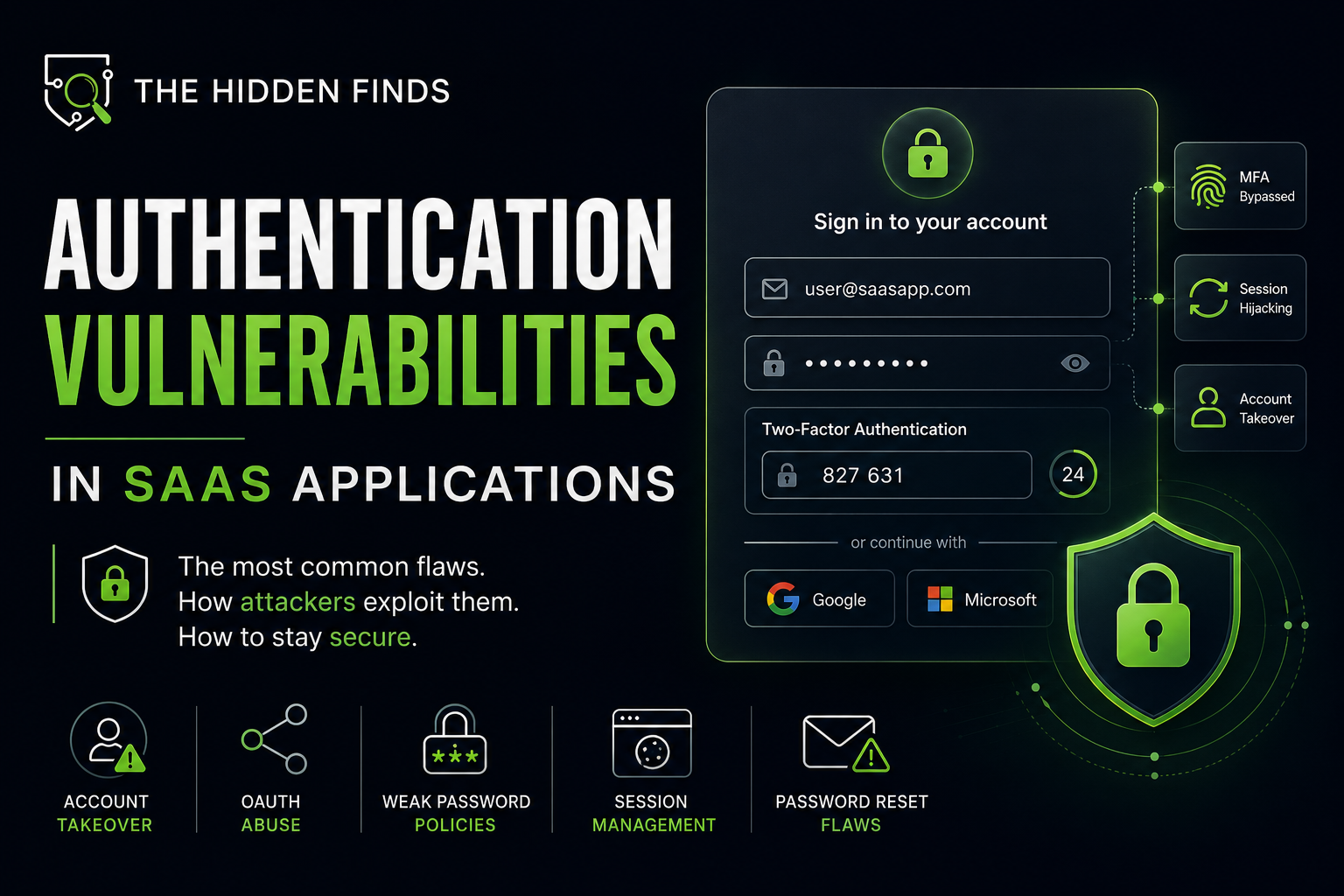
Authentication is one of the most important security controls in any SaaS application. It determines who can access a system, what resources they can reach, and how user identities are verified. Every login page, mobile application, API, and third-party integration ultimately relies on authentication to establish trust between users and the platform.
Because authentication sits at the center of modern applications, it has also become one of the most attractive targets for attackers. A successful authentication bypass or account takeover often provides direct access to sensitive customer data, internal functionality, payment information, and administrative features. In many real-world incidents, attackers do not need sophisticated exploits or malware. They simply find weaknesses in the way authentication has been implemented.
For SaaS companies, understanding these weaknesses is critical. Many authentication vulnerabilities appear small during development but can have significant consequences once exposed to the internet. The challenge is that these issues often exist in systems that appear to be functioning correctly. Users can log in, sessions work as expected, and applications pass basic testing. Yet beneath the surface, attackers may be able to abuse authentication flows in ways the development team never anticipated.
One of the most common authentication risks remains weak password security. Despite years of security awareness efforts, password reuse continues to be widespread. Many users still reuse the same password across multiple services. When one of those services experiences a breach, attackers collect the exposed credentials and attempt to reuse them against other platforms. This technique, commonly known as credential stuffing, remains one of the most effective account takeover methods because it exploits human behavior rather than technical vulnerabilities.
Weak password policies can make this problem even worse. Applications that allow simple or easily guessable passwords increase the likelihood of successful attacks. While password complexity alone is not a complete solution, organizations should encourage strong passwords and support password managers to reduce the risk of reused credentials.
Another major authentication weakness involves inadequate protection against automated login attempts. Attackers frequently use password spraying techniques, where a small number of common passwords are tested against a large number of accounts. Unlike traditional brute-force attacks, password spraying is designed to avoid account lockouts and rate-limiting controls. Applications that lack effective monitoring, throttling, or login protections are particularly vulnerable to these attacks.
Multi-factor authentication has become one of the most effective defenses against account takeover. However, simply enabling multi-factor authentication does not automatically solve every problem. Many organizations fail to enforce it consistently, leaving certain user groups or administrative accounts unprotected. In some environments, recovery workflows can also introduce weaknesses that effectively bypass the protection provided by multi-factor authentication. If an attacker can abuse an account recovery process, they may gain access without needing the second authentication factor at all.
Session management vulnerabilities are another common source of authentication-related risk. Once a user successfully authenticates, the application typically issues a session token or authentication token that represents the user’s identity. If these tokens are not handled securely, attackers may be able to steal, replay, or reuse them. In some applications, authentication tokens remain valid for extended periods of time or are not properly invalidated after password changes. This creates situations where an attacker who previously obtained access can continue interacting with the application even after the legitimate user attempts to secure their account.
OAuth and single sign-on integrations introduce additional complexity. Modern SaaS applications frequently rely on external identity providers such as Google, Microsoft, GitHub, or other authentication platforms. These integrations simplify the login experience for users, but they also create new trust relationships that must be managed carefully. Misconfigured OAuth implementations, excessive permissions, poorly validated redirect flows, and long-lived access tokens can all introduce security risks. Attackers increasingly target these trust relationships because compromising a single integration can sometimes provide access to multiple connected systems.
Password reset functionality is another area that deserves careful attention. Password reset features are designed to help legitimate users regain access to their accounts, but they are also frequently targeted by attackers. Weak reset token generation, predictable verification codes, excessive reset attempts, and poorly implemented recovery workflows can create opportunities for unauthorized access. In many cases, attackers focus on recovery mechanisms because they are often less scrutinized than the primary login process.
Authentication vulnerabilities are not limited to traditional login forms. APIs introduce their own unique challenges. Many SaaS platforms rely heavily on APIs for mobile applications, third-party integrations, and internal services. When API authentication is implemented incorrectly, attackers may be able to bypass authorization checks, reuse tokens, abuse refresh mechanisms, or access protected functionality without proper verification. As organizations become increasingly API-driven, authentication security must extend beyond the user interface and into every backend service that processes requests.
One of the most overlooked authentication risks is excessive trust. Developers often assume that because a user has successfully authenticated, every request that follows can be trusted. In reality, authentication only establishes identity. Security decisions must continue throughout the entire application lifecycle. Access controls, session validation, token verification, and permission checks remain essential even after authentication has succeeded. Many serious vulnerabilities occur because applications trust authenticated users more than they should.
A common pattern observed during security assessments is that authentication systems are tested primarily for functionality rather than abuse scenarios. Development teams verify that users can log in, reset passwords, and access their accounts. Attackers test something entirely different. They evaluate how authentication behaves under unexpected conditions, whether recovery workflows can be manipulated, whether tokens can be reused, and whether trust boundaries can be bypassed. The difference between these perspectives often determines whether a vulnerability is discovered internally or by an attacker.
Improving authentication security requires more than implementing a login page and enabling multi-factor authentication. Organizations should evaluate password policies, monitor for credential abuse, enforce strong session management practices, review OAuth integrations carefully, secure password recovery workflows, and continuously assess authentication mechanisms through practical security testing. Authentication should be treated as an evolving security control rather than a one-time implementation.
As SaaS applications continue to grow in complexity, authentication will remain one of the most important areas of security investment. Attackers understand that gaining access to a legitimate account is often more valuable than exploiting a technical vulnerability. Once authenticated, they can operate within trusted boundaries and blend into normal application activity.
For that reason, strong authentication security is not simply about preventing unauthorized logins. It is about protecting the foundation upon which every other security control depends.
Final Thoughts
Many of the most damaging security incidents begin with something surprisingly simple: an attacker gaining access to an account they should never have controlled in the first place.
Whether the entry point is credential stuffing, weak session management, insecure password recovery, OAuth abuse, or poorly protected APIs, the result is often the same. Once authentication fails, every other layer of security becomes significantly harder to trust.
For SaaS companies, authentication should never be viewed as a solved problem. It should be reviewed, tested, and improved continuously as applications evolve. The organizations that treat authentication as a critical security function rather than a basic feature are far better positioned to prevent account takeovers, protect customer data, and reduce real-world risk.
Helping SaaS companies identify real-world exploitable vulnerabilities through penetration testing, API security testing, application security assessments, and practical attack-surface analysis.