For years, application security teams have asked a familiar question: What can this user access? That question still matters.
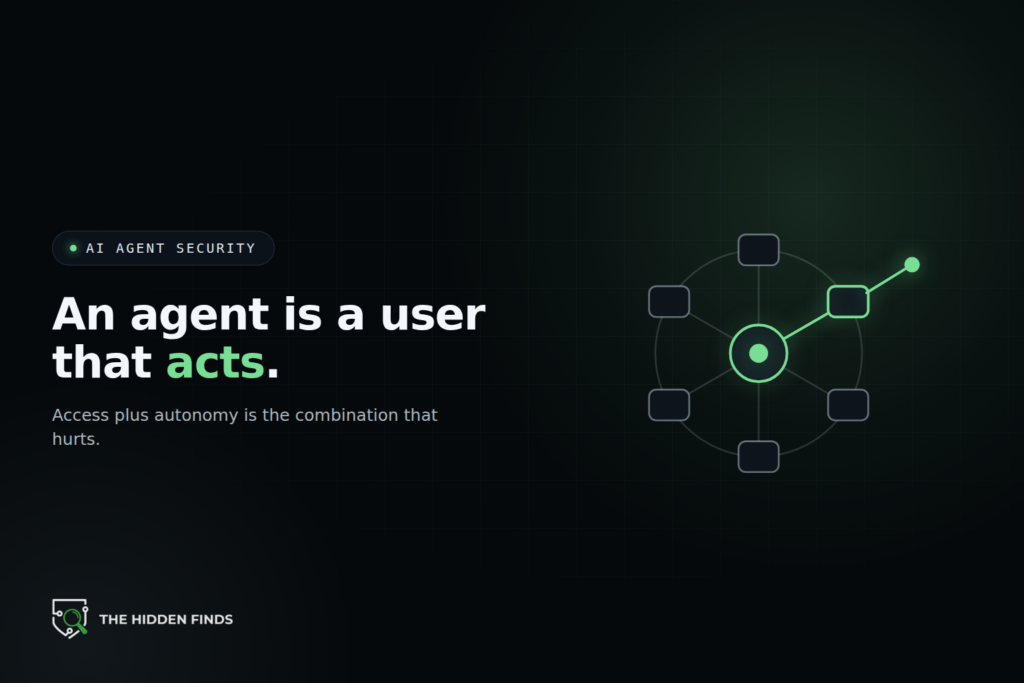
But as AI agents become integrated into SaaS platforms, companies increasingly need to ask another one: What can this AI agent access, and what can it do with that access? That distinction is becoming important.
AI is moving beyond the chatbot sitting in the corner of a website answering basic questions. Modern AI agents can interact with APIs, search company documents, retrieve customer information, send emails, update records, trigger workflows, access third-party services, and sometimes perform actions on behalf of users.
The more useful these agents become, the more access they need. And that access creates a new attack surface.
The security problem is therefore no longer limited to whether an LLM produces an incorrect answer. The bigger question is what happens when an AI system with real permissions makes the wrong decision, processes malicious instructions, or is given access to something it should never have been able to reach.
That is where AI agent security starts becoming an application security problem.
The Shift From AI That Answers to AI That Acts
The first generation of AI integrations was relatively simple. A user entered a prompt. The LLM generated an answer. The interaction largely ended there.
Agentic systems are different. Imagine a SaaS company introducing an AI assistant for its customers. Instead of simply answering questions, the assistant can now search documents, retrieve customer records, update CRM information, generate reports, interact with internal APIs, create support tickets, or trigger other business workflows.
From the user’s perspective, this is incredibly useful. From a security perspective, something fundamental has changed.
The AI system is no longer only processing information. It has authority. And authority has always been one of the most important things attackers look for.
OWASP describes a related problem as Excessive Agency: an AI-enabled system can cause damaging actions when it has excessive functionality, excessive permissions, or excessive autonomy. This means companies cannot secure AI agents by looking only at the model. They also have to secure everything the agent can reach.
Think of an AI Agent as Another User
There is a useful way for SaaS companies to think about this. Imagine hiring a new employee. On their first day, would you give that employee access to every customer account, every internal document, production databases, billing systems, administrative APIs, email accounts, and the ability to delete information?
Probably not. You would decide what that employee actually needs. Then you would grant the appropriate permissions.
An AI agent should be treated similarly. If an agent exists only to summarize support tickets, why should it be able to delete them? If an agent needs to read customer information, why should it automatically be allowed to modify customer accounts? If an agent operates for Customer A, why should it ever be capable of retrieving information belonging to Customer B?
These sound like obvious questions. But the history of application security shows that authorization problems often begin with exactly these kinds of assumptions.
The same principle behind traditional least privilege now needs to apply to AI agents. OWASP’s recent guidance recommends limiting agents to the tools, data, and authority required for their specific tasks, while requiring additional controls for high-impact actions.
The Attack Surface Is Bigger Than the AI Model
When people hear “AI security,” prompt injection is often the first vulnerability that comes to mind. Prompt injection is important. But it is only one part of the problem.
Consider an AI agent connected to several systems:
- User Asks the agent for something in ordinary language, with no idea which systems that will touch.
- AI agent Decides on its own which tools to call and what arguments to pass.
- Internal API Called with the application’s own credentials rather than the user’s, so the agent’s reach is the integration’s reach.
- Customer database Reached through that API at whatever scope those credentials allow, which is usually wider than the user’s.
- Connected CRM A separate system the agent can read from and write to on the user’s behalf.
- Email and messaging An action with effects outside your application, and one you cannot take back once it fires.
- Third party services Everything reachable beyond your own boundary. This is the end of the chain and the edge of your control.
Every connection introduces another trust relationship. The agent needs an identity. That identity needs permissions.
Those permissions provide access to APIs. Those APIs provide access to data. And some of those APIs may allow actions to be performed.
Suddenly, something that looked like a simple AI feature has inherited the security implications of several different systems.
This is why the security boundary around AI agents needs to include much more than prompts. It includes authentication, authorization, APIs, credentials, tenant isolation, tools, external content, business logic, data access, and the actions an agent is allowed to perform.
Recent OWASP analysis of AI security incidents describes a broader transition from theoretical AI risks toward real-world problems involving agent identities, orchestration layers, excessive permissions, prompt injection, and weak validation controls. That should matter to every company building AI into an existing SaaS application.
What Happens When an Agent Has Too Much Access?
Imagine a company has an AI agent connected to its customer-management platform. The agent needs customer information to answer support questions, so developers give it access to a customer API. That sounds reasonable.
But what if the API does not properly enforce tenant boundaries? A normal user may only see records belonging to their organization because the frontend restricts what they can request. The AI agent, however, may be communicating directly with the backend using a more privileged service identity. Now imagine an attacker manages to influence what the agent requests.
The security problem is no longer simply:
“Can I trick the AI into saying something strange?”
It becomes:
“Can I make the AI retrieve something I am not authorized to see?”
That difference is enormous. And it leads straight back to traditional application security. The agent should never become a shortcut around the authorization controls that already protect the application.
Prompt Injection Becomes More Dangerous When AI Has Tools
There is another important difference between traditional chatbots and AI agents. Imagine an AI system reads a document containing malicious instructions.
A simple chatbot might produce an incorrect or manipulated response. An agent with tools could potentially do much more. Depending on its permissions, it might query another system, disclose information, modify something, send data elsewhere, or initiate another workflow.
This is why prompt injection and excessive permissions can become particularly dangerous when combined. OWASP recommends treating prompts, retrieved documents, tool responses, external content, and messages from other agents as untrusted inputs. It also recommends explicit human confirmation before irreversible or high-impact actions.
The important lesson is simple: AI should not become trusted simply because the application generated the request. Authorization still needs to happen at the system performing the action.
Tenant Isolation Becomes Even More Important
For SaaS companies, there is another area that deserves particular attention. Tenant isolation.
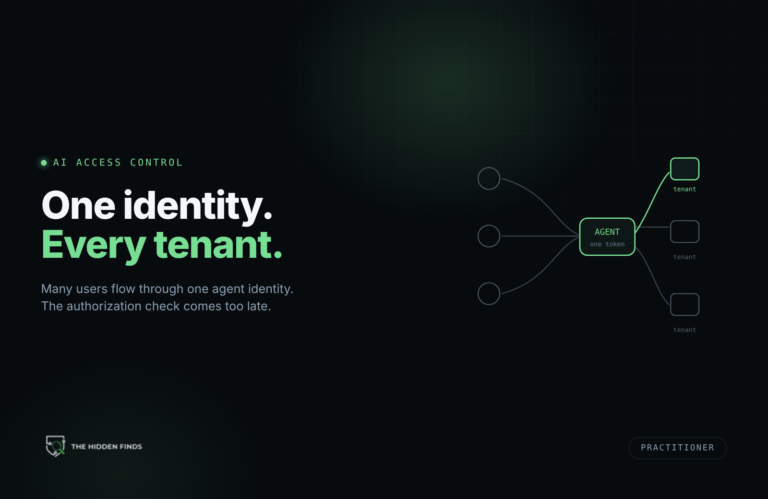
A SaaS platform may serve thousands of organizations using the same infrastructure. Customer A must never be able to access Customer B’s information. Traditionally, applications enforce that separation using authorization checks around users, organizations, objects, and API requests.
AI agents introduce another layer into that architecture. Suppose an agent can search documents across an organization. What determines the organization it searches?
Suppose it retrieves customer records. Where is the tenant scope enforced? Suppose the agent calls an internal API. Does the API independently verify authorization, or does it assume that the AI agent has already done so?
Those questions should be answered before an AI agent receives production access.
Tenant isolation must be enforced by the underlying application, not delegated to the LLM. An AI instruction saying “only access the current customer’s information” is not an authorization control. Server-side authorization is.
The Most Dangerous Combination: Access + Autonomy
Giving an AI agent access creates risk. Giving it autonomy increases that risk.
An agent that can read information has one level of impact. An agent that can modify information has another. An agent that can delete information, change permissions, initiate payments, send messages, publish content, or trigger workflows has a much larger potential blast radius.
OWASP’s agentic security guidance specifically highlights risks where agents can perform high-impact operations across integrated systems. Recommended safeguards include separating permissions between systems, creating immutable audit trails, using reversible transactions where possible, and requiring confirmation before destructive operations.
This gives SaaS teams a useful principle: The more irreversible an action is, the less autonomy the AI should have over it.
Reading a public knowledge-base article may require little oversight. Deleting customer data should require significantly more.
Data Leakage and Decisions Built on AI Output
Not every AI risk involves an agent taking an action. AI systems generate responses based on training data, context, or connected sources, and if that is not handled properly it can lead to exposure of sensitive information, leakage of internal data, or unintended disclosure of system behavior. The risk is not always obvious, because the system appears to be functioning correctly. But under certain inputs, it may reveal more than intended.
AI also participates in workflows: approving requests, automating tasks, and generating outputs used by other systems. That introduces a new layer of business logic risk. Attackers can manipulate inputs to bypass controls, influence automated decisions, or trigger workflows in unintended ways. Any output that another system acts on deserves the same validation as input from a user.
How SaaS Companies Can Secure AI Agents
The good news is that companies do not need to abandon AI agents to use them safely. They need to design the surrounding security controls correctly.
Start with least privilege. An AI agent should receive only the permissions necessary for its specific job. If it needs read access, do not automatically grant write access. If it works with one dataset, do not expose another simply because using the same credential is convenient.
Next, enforce authorization at every API boundary. Never assume that because an AI agent made the request, the request is authorized. The backend should independently determine whether the agent and the user it represents are permitted to access the requested resource.
Then protect tenant isolation. Every data request should remain scoped to the appropriate customer or organization. Manipulating an identifier, prompt, tool parameter, or agent instruction should never allow one tenant’s context to cross into another.
Companies should also separate low-risk and high-risk actions. Reading data and deleting data should not require the same level of trust. Sensitive actions such as modifying permissions, sending communications, publishing information, transferring money, or deleting records should have stronger controls and, where appropriate, human approval.
Credentials deserve the same attention. AI agents should not receive broad, permanent credentials simply because doing so makes integration easier. Credentials should be narrowly scoped, rotated, monitored, and separated between services whenever possible.
Finally, companies need visibility. Every meaningful action performed by an agent should be logged.
Security teams should be able to answer: What did the agent access? Which user initiated the interaction? Which tools did it call?
What information was returned? What action did it perform? And what authorization decision allowed it?
Without that visibility, investigating an AI-related security incident becomes significantly harder.
AI Agents Need Security Testing Too
There is one final mistake companies should avoid. Testing only whether the AI gives good answers.
An AI agent can behave perfectly during normal testing and still have serious security weaknesses. Security testing needs to examine what happens when assumptions are deliberately broken.
What happens when identifiers are manipulated? What happens when an agent is asked to access another user’s information? What happens when retrieved content contains malicious instructions?
Can the agent call tools outside its intended purpose? Can it perform an action the user themselves could not perform? Can one customer influence information returned to another customer?
Can the agent access hidden or unpublished resources? Can permissions be chained across multiple integrations?
These are application-security questions. And answering them requires testing the entire system surrounding the model, not simply evaluating the model itself.
OWASP’s 2026 work on AI and agentic red teaming similarly argues that organizations need adversarial testing across the AI lifecycle because agentic systems introduce risks including privilege escalation, prompt injection, model misuse, data poisoning, and emergent behavior.
The Next Attack Surface Has Already Arrived
AI agents are going to become increasingly capable. That is not necessarily something companies should fear. But capability and security need to grow together.
Every new API an agent can call, every dataset it can access, every SaaS application it can control, and every action it can perform expands its potential attack surface.
The companies that handle this well will not simply ask:
“What can our AI do?”
They will also ask:
“What should our AI never be allowed to do?”
That second question is where security begins.
For SaaS companies, the fundamentals remain surprisingly familiar: enforce authorization, protect tenant boundaries, minimize privileges, validate inputs, secure credentials, monitor actions, and test assumptions before attackers do.
AI may be changing how applications operate. But the fundamental security principle has not changed:
Never give more trust than necessary.
At The Hidden Finds, I focus on identifying these kinds of hidden trust and authorization problems across modern SaaS applications, APIs, and emerging AI-powered workflows. As AI agents become more deeply connected to production systems, I will continue exploring this new attack surface and the practical security controls companies need to protect it. This is only the beginning.