
Introduction
Penetration testing is no longer optional—especially for startups and scaling companies handling user data, APIs, and financial workflows. But while many organizations invest in security testing, very few understand the standards and methodologies behind it.
And that’s where problems begin.
Because without proper frameworks, penetration testing becomes:
- inconsistent
- surface-level
- or worse, focused on theoretical findings instead of real risk
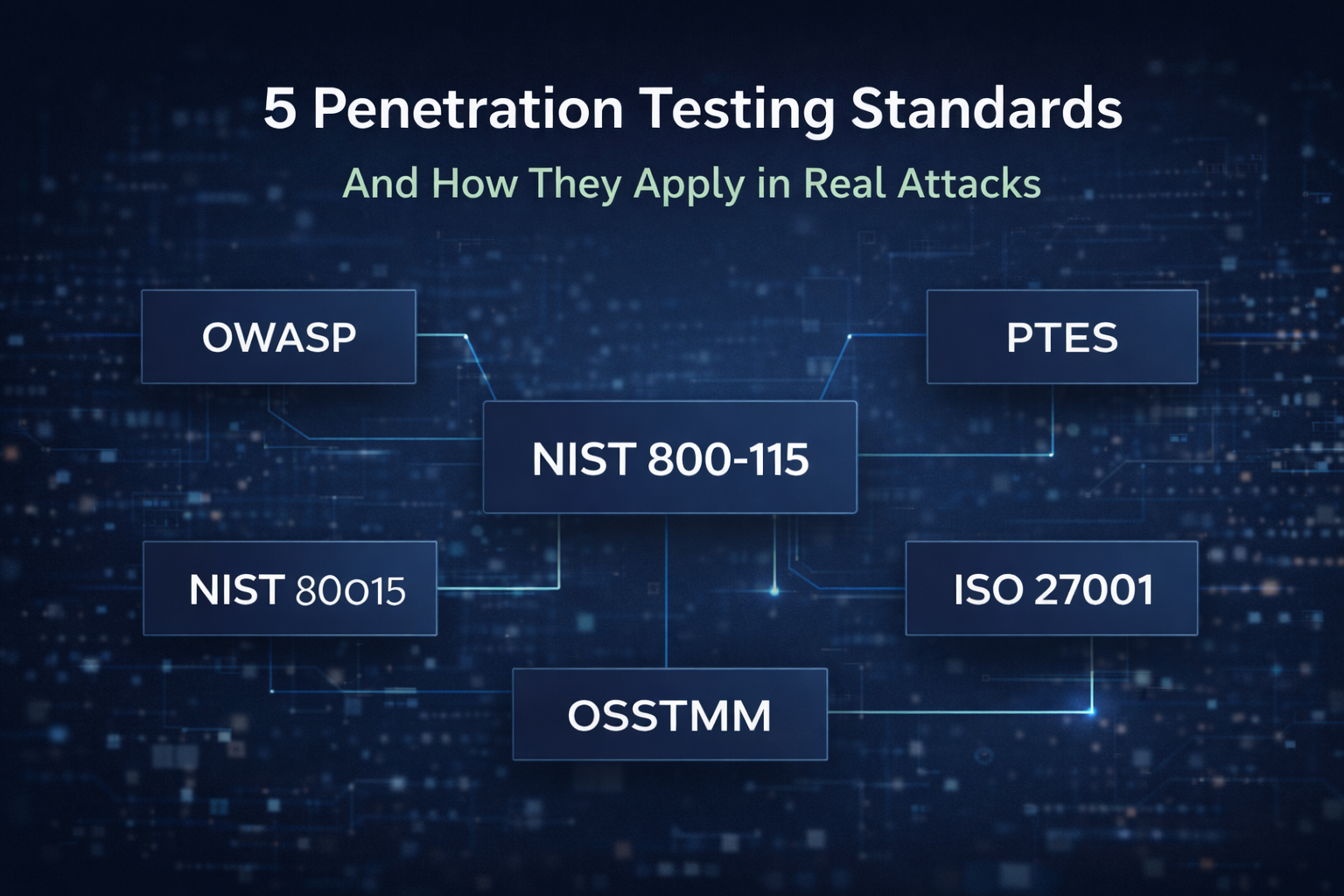
In this article, we’ll break down five essential penetration testing standards every organization should know—and more importantly, how they actually apply to real-world vulnerabilities like IDOR, authentication flaws, and business logic issues.
Why Penetration Testing Standards Matter
Penetration testing standards provide structure—but their real value lies in consistency and depth.
Without them:
- critical attack paths are missed
- testing becomes tool-driven instead of attacker-driven
- reports lack real business impact
A strong methodology ensures:
- coverage across web applications, APIs, and infrastructure
- repeatable testing processes
- realistic attack simulations
However, it’s important to understand this:
Standards guide the process—but they don’t guarantee real-world exploitability.
That depends on how the testing is executed.
1. OWASP Testing Guide
The OWASP Testing Guide is one of the most widely used frameworks for web application security testing.
It focuses on identifying vulnerabilities such as:
- Broken Access Control (IDOR)
- Authentication flaws
- Injection vulnerabilities
- Security misconfigurations
Why it matters:
OWASP is especially valuable for modern SaaS and API-driven applications, where most real-world vulnerabilities exist.
Real-world relevance:
Many high-impact bugs—like IDOR and authorization bypass—fall directly under OWASP categories but are often missed when testing is purely automated.
2. PTES (Penetration Testing Execution Standard)
PTES provides a full lifecycle approach to penetration testing.
It covers:
- Pre-engagement interactions
- Intelligence gathering
- Threat modeling
- Exploitation
- Reporting
Why it matters:
PTES ensures testing isn’t just technical—it aligns with business risk and real attack scenarios.
Real-world relevance:
Instead of isolated vulnerabilities, PTES encourages:
- multi-step attack chains
- privilege escalation paths
- deeper system understanding
-This is critical when testing complex applications with workflows, roles, and permissions.
3. NIST SP 800-115
NIST provides structured guidelines for:
- network security testing
- vulnerability assessments
- penetration testing methodologies
Why it matters:
It’s widely used in enterprise environments and compliance-driven organizations.
Real-world relevance:
While NIST is strong in structure, it tends to focus more on:
- process
- documentation
- compliance
-But it may not go deep enough into modern application-layer attacks, especially APIs and business logic flaws.
4. ISO 27001 (Security Management Perspective)
ISO 27001 is not a penetration testing standard directly—it’s a security management framework.
It requires:
- regular security assessments
- risk management
- continuous improvement
Why it matters:
Organizations aiming for compliance often include penetration testing as part of their ISO controls.
Real-world relevance:
ISO ensures testing happens regularly—but:
-It doesn’t define how deep or effective the testing should be
Which means:
- you can be compliant
- and still vulnerable
5. OSSTMM (Open Source Security Testing Methodology Manual)
OSSTMM is a detailed framework focused on:
- measurable security testing
- operational security metrics
- consistent methodology
Why it matters:
It introduces the idea of quantifying security, not just identifying vulnerabilities.
Real-world relevance:
Useful for structured environments, but:
- can be complex
- not always aligned with fast-moving SaaS environments
The Gap Most Companies Miss
Here’s the reality:
–Following standards ≠ being secure
Most organizations:
- follow OWASP checklists
- run automated scans
- generate reports
But still miss:
- IDOR vulnerabilities
- business logic flaws
- authentication bypasses
- multi-step exploit chains
Why?
Because real attackers:
- don’t follow checklists
- don’t stop at one vulnerability
- think in attack paths, not categories
What Effective Penetration Testing Looks Like
Modern penetration testing should combine:
- structured standards (like OWASP & PTES)
- real-world attacker mindset
- manual testing of application logic
This includes:
- chaining vulnerabilities together
- testing workflows (not just endpoints)
- validating real exploitability
-The goal isn’t just to find vulnerabilities
-The goal is to understand how they can be exploited
Final Thoughts
Penetration testing standards are essential—but they are only the starting point.
To truly secure modern applications, organizations need testing that goes beyond:
- automated tools
- compliance checklists
- theoretical findings
They need:
- practical insights
- real attack simulation
- actionable fixes
Because in the end:
-Security isn’t about how many issues you find
-It’s about which ones actually matter